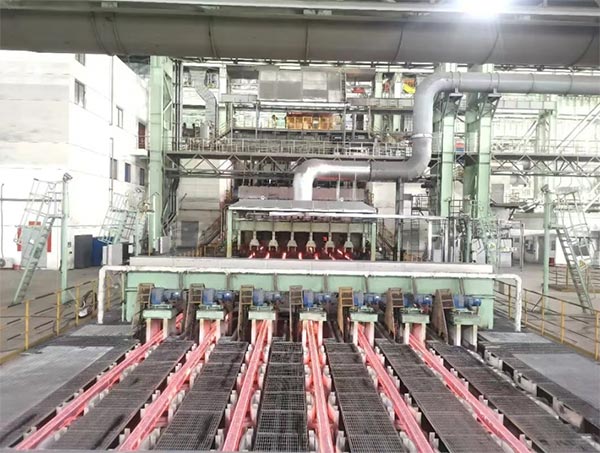
In billet continuous casting production, the crystallizer copper tube is one of the most important functional components in the entire casting system. It is often regarded as the “heart” of the billet continuous casting machine because it directly affects shell formation, heat transfer, casting stability, billet surface quality, and overall production efficiency. Once the copper tube experiences abnormal wear, leakage, scratches, or shortened service life, the continuous caster may face frequent interruptions, higher spare part consumption, increased maintenance workload, and greater production cost.
Recently, the No. 1 billet continuous casting machine in the new continuous casting operation area achieved a major breakthrough in crystallizer copper tube performance. The highest throughput of a single copper tube reached 13,952 tons, representing an increase of 76.6% compared with the initial stage of equipment commissioning. At the same time, the spare parts cost of copper tubes was reduced to 0.18 yuan per ton. This improvement delivered a clear double benefit: higher production efficiency and lower operating cost. It also created a stronger foundation for stable production, better equipment reliability, and long-term efficiency improvement.
Why the Crystallizer Copper Tube Matters
The crystallizer copper tube plays a decisive role in the early solidification stage of molten steel. In billet casting, molten steel enters the mold and rapidly transfers heat to the cooling system through the copper tube. This process allows a stable shell to form around the liquid core of the steel strand. If the copper tube condition is poor, heat transfer may become uneven, leading to shell instability, internal stress, surface cracks, breakout risk, and billet quality problems.
In practical production, the operating condition of the copper tube directly influences:
-
- casting stability
-
- mold heat transfer efficiency
-
- billet surface and internal quality
-
- equipment availability
-
- replacement frequency
-
- spare parts cost
-
- overall production rhythm
For this reason, improving continuous casting copper tube throughput is not only a maintenance target, but also a strategic production objective for steel plants seeking higher efficiency and lower cost.
Main Challenges: Wear, Leakage, and Short Service Life
Since the No. 1 billet continuous casting machine was commissioned, the technical team has consistently focused on the core target of improving efficiency and reducing cost. Among all related tasks, increasing the steel throughput of the crystallizer copper tube was identified as a priority.
The key challenges were clear: rapid wear of the copper tube, relatively short service life, risk of leakage, and unstable operation under certain production conditions. These issues are common in billet casting operations, especially during the early stage of equipment use, when production organization, operating practices, and parameter matching are still being optimized.
To solve these problems, the operation area gradually developed a practical and systematic technical management approach through continuous testing, data tracking, process analysis, and field improvement.
Key Measures That Improved Copper Tube Throughput
1. Optimized production organization
The team improved the production organization model by arranging a more suitable steel grade sequence and controlling process transitions more carefully. Rational matching of steel grades reduced fluctuations in thermal load and helped avoid abnormal operating conditions that accelerate copper tube wear.
At the same time, the superheat of molten steel was strictly controlled. Stable and appropriate superheat reduced unnecessary thermal stress in the mold area, improved initial solidification conditions, and lowered the probability of abnormal erosion and leakage.
2. Standardized key operating procedures
Standardization of critical operator actions was another important measure. In operations such as pouring and changing the water inlet, workers were required to control the liquid level in the crystallizer more precisely and place cold materials in an orderly and accurate manner.
This detail-oriented control reduced excessive mold fluctuation, minimized mechanical scratches on the copper tube, and improved overall casting consistency. In continuous casting, small operating deviations can lead to repeated mechanical damage, so standardization at key positions became an essential part of wear control.
3. Improved parameter matching of the copper tube
The technical team also optimized equipment parameter adaptation according to actual production needs. One important adjustment was the appropriate increase of the inverted taper of the crystallizer copper tube.
This change improved billet demolding performance and reduced friction between the billet shell and the inner wall of the copper tube. As a result, the wear rate of the inner wall decreased, helping extend the service life of the mold copper tube and maintain more stable heat transfer conditions over a longer operating period.
4. Strengthened cooling water system management
Cooling water quality has a direct impact on mold heat transfer and copper tube protection. The work area strengthened cooling water system management through water quality optimization and more standardized routine control.
By improving the stability of cooling water indicators, the team ensured more uniform heat exchange in the crystallizer. This prevented local overheating, reduced uneven thermal stress, and avoided damage caused by local friction or unstable cooling conditions. Good crystallizer cooling water management proved to be one of the most effective support measures for longer copper tube life.
5. Established full life cycle management
Another major improvement was the implementation of full life cycle management for crystallizer copper tubes. The team further standardized procedures for stopping casting and feeding the dummy bar, while strengthening online status monitoring of copper tube condition.
This enabled operators and technicians to identify wear trends in time, monitor service status more accurately, and carry out dynamic, refined management throughout the entire use cycle of each copper tube. Instead of reacting only after visible damage occurred, the team shifted toward preventive and data-based control.
Results: Higher Efficiency and Lower Cost
The improvement in crystallizer copper tube throughput produced both technical and economic benefits. On the production side, longer service life reduced the frequency of mold replacement, shortened downtime related to equipment change, and improved the operating rate of the billet continuous casting machine. This directly supported smoother casting operations and a more stable production schedule.
On the cost side, lower spare part consumption significantly reduced operating expenses. Based on annual casting volume, the company estimates that copper tube spare parts cost can be reduced by more than 200,000 yuan per year. This demonstrates that mold copper tube optimization is not a minor maintenance issue, but an important driver of cost reduction and efficiency improvement in continuous casting plants.
Why This Case Matters to the Steel Industry
This case shows that increasing mold copper tube throughput does not rely on a single adjustment. It requires a coordinated strategy that combines production organization, operator standardization, process control, equipment parameter optimization, cooling water management, and full life cycle monitoring.
For steel plants operating billet continuous casting machines, this experience offers a practical reference. When copper tube wear, leakage, or short service life becomes a bottleneck, the most effective solution is usually a systematic one. By addressing both process conditions and management details, manufacturers can significantly improve billet caster efficiency, enhance billet quality, and reduce total production cost.
Conclusion
The successful improvement of crystallizer copper tube throughput in the No. 1 billet continuous casting machine is a valuable example of how process optimization and refined management can deliver measurable results. With the highest single copper tube throughput reaching 13,952 tons and spare part cost falling to 0.18 yuan per ton, the project demonstrates how technical innovation can support stable production, stronger cost control, and better equipment performance.
For modern steelmakers, optimizing the continuous casting copper tube is not only about extending service life. It is also about improving billet casting quality, increasing equipment efficiency, reducing downtime, and strengthening competitiveness in an increasingly cost-sensitive market.
